

 Course Catalog
 Laura Artman
Healthy Aging: 7 Powerful Skin Care Strategies
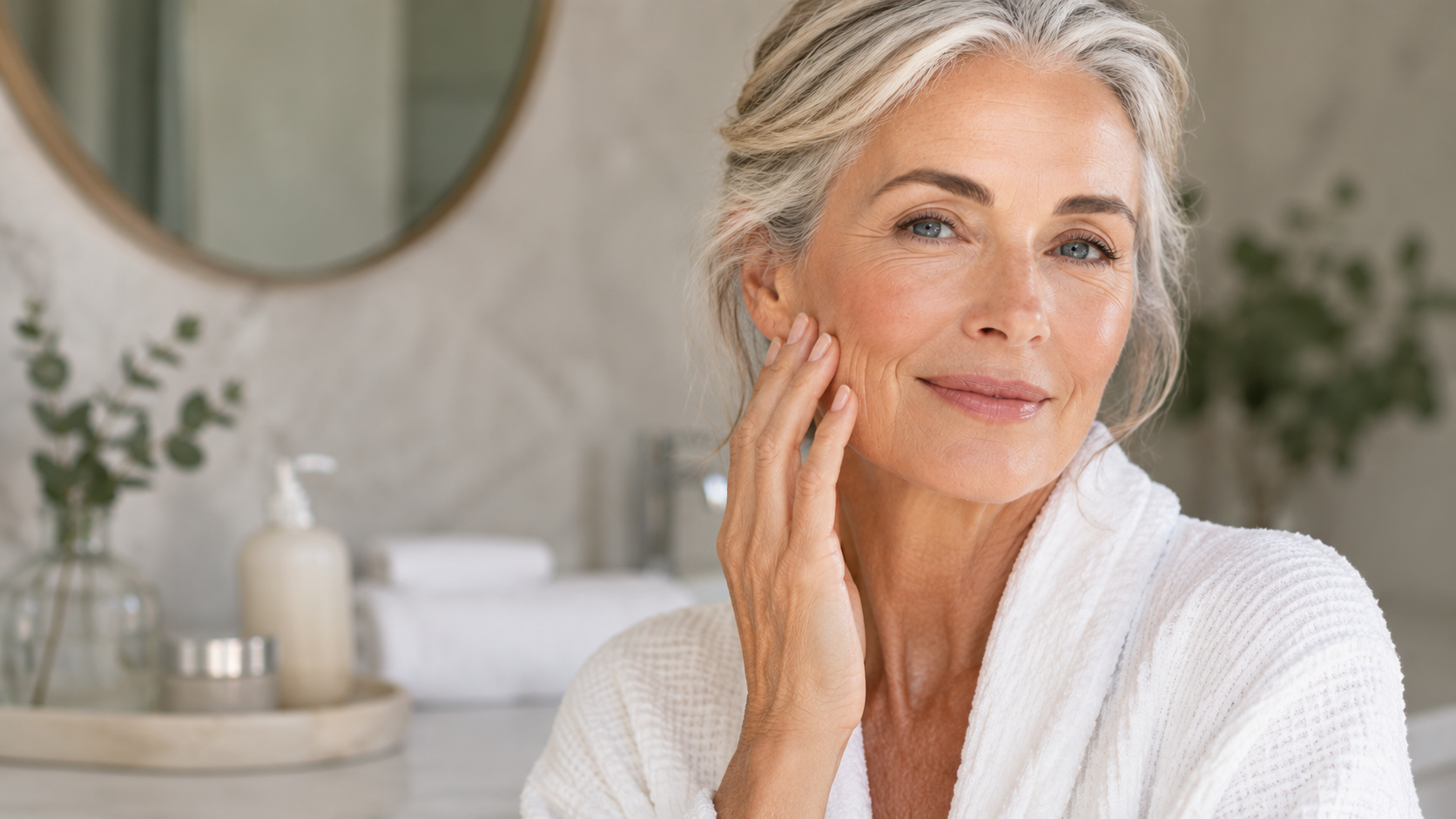
Healthy aging involves far more than maintaining physical fitness, managing nutrition, and staying active. Skin health is also an important part of the aging process. As the years pass, the skin naturally becomes thinner, drier, less elastic, and more susceptible to environmental damage. Fine lines, wrinkles, age spots, uneven pigmentation, and undereye bags may become increasingly noticeable.
These changes are a normal part of aging, but that does not mean skin care should be ignored. A consistent approach to cleansing, moisturizing, sun protection, and targeted skin care can help maintain healthier-looking skin as you age.
Harvard Health Publishing explains that several biological changes occur in aging skin. Collagen and elastin gradually break down, oil production decreases, skin becomes thinner, and the normal process of shedding older skin cells slows. Years of ultraviolet exposure can also contribute to pigmentation changes and accelerate visible skin aging.
The objective of healthy aging is not to stop these natural processes. Instead, effective skin care can focus on protecting the skin, maintaining hydration, and addressing specific concerns as they develop.
1. Protect Your Skin From the Sun
Sun protection is one of the most important components of healthy aging.
Ultraviolet radiation contributes significantly to premature skin aging. Harvard Health notes that UV exposure accelerates the breakdown of collagen and elastin and can cause DNA damage associated with skin cancer. Daily broad-spectrum sunscreen with an SPF of at least 30 is recommended, including on cloudy days and during winter.
Sun protection should extend beyond sunscreen. Wearing sunglasses and a hat can reduce direct UV exposure to the face and delicate skin around the eyes.
Consistent protection is more important than occasional intensive protection. A daily sunscreen routine can become one of the simplest long-term investments in healthy aging skin.
2. Keep Healthy Aging Skin Properly Hydrated
Aging skin often becomes drier because oil glands produce less oil over time. The result can be roughness, tightness, flaking, and a more noticeable appearance of fine lines.
Harvard Health recommends regular moisturizing and specifically identifies fragrance-free moisturizers as an option for aging skin. Products containing ingredients such as hyaluronic acid or glycerin can help maintain hydration.
Moisturizer should be applied regularly, particularly after bathing or showering and whenever the skin feels dry.
Hydration does not reverse the aging process, but maintaining the skin's moisture can improve its texture and appearance while supporting the skin barrier.
3. Use a Gentle Cleanser
More aggressive cleansing is not necessarily better skin care.
Harvard Health recommends using a mild cleanser rather than harsh soaps that can strip the skin of its natural moisture. For aging skin, excessive cleansing or the use of overly harsh products can contribute to dryness and irritation.
A simple routine is often sufficient: gently cleanse the skin, rinse thoroughly, and apply moisturizer afterward.
The goal is to remove dirt, oil, sunscreen, and other surface residue without unnecessarily disrupting the skin barrier.
4. Consider Antioxidants
Antioxidants are another component of a skin-care routine designed around healthy aging.
Harvard Health highlights vitamin C as an example of an antioxidant used in topical skin-care products. Vitamin C can help protect against environmental damage, brighten the appearance of the skin, improve uneven skin tone, and reduce the appearance of dark spots by influencing excess pigment production.
A vitamin C product can therefore address more than one cosmetic concern.
However, introducing multiple active ingredients simultaneously is not always necessary. A simpler routine that can be followed consistently may be more useful than an elaborate collection of products that causes irritation or becomes difficult to maintain.
5. Exfoliate Carefully
Skin-cell turnover naturally slows with age. Exfoliation can remove some dead surface cells and make the skin appear fresher.
Harvard Health recommends gentle exfoliation once or twice per week and notes that chemical exfoliation may be preferable to physical exfoliation for anti-aging purposes. Examples of chemical exfoliating ingredients include retinoids, alpha-hydroxy acids, beta-hydroxy acids, and salicylic acid.
More exfoliation is not necessarily better.
Using exfoliating products too frequently or applying more product than directed can leave the skin raw, irritated, or damaged. Aging skin may already be more delicate, making moderation particularly important.
6. Address Age Spots and Uneven Pigmentation
Age spots, also called solar lentigines, commonly appear on areas of skin that receive substantial sun exposure. They can occur on the face, hands, shoulders, and other exposed areas and become more common with age.
Several treatment approaches may reduce their appearance.
Topical ingredients such as vitamin C, retinoids, and hydroquinone may be used in products designed to fade pigmentation. Dermatologists can also provide stronger prescription treatments when appropriate.
Professional treatments can include chemical peels and laser therapy. These treatments are more intensive and require appropriate evaluation because not every treatment is appropriate for every skin type or condition.
There is also an important safety consideration: a spot that changes in shape, color, or size should not simply be treated as a cosmetic problem. Harvard Health recommends having irregular age spots evaluated because changes can indicate skin cancer.
7. Target Wrinkles and Undereye Concerns
Wrinkles develop as the skin loses elasticity and structural support. Sun exposure, repeated facial expressions, and gravity can contribute to their development.
Retinoids are among the more established topical options for addressing wrinkles. Harvard Health explains that retinoids can increase collagen production, improve skin thickness, and smooth the outer layer of the skin. Prescription retinoids include tretinoin and tazarotene, while retinol and retinal are available in many over-the-counter products.
Undereye bags are different from ordinary wrinkles. Dark circles and puffiness can be influenced by genetics, sleep, fluid retention, and age-related changes to the muscles and tissues surrounding the eyes.
Harvard Health identifies several approaches that may temporarily improve their appearance, including cold compresses, caffeine-containing eye products, peptides, and sleeping on the back with the head slightly elevated. More significant concerns may require professional treatments such as fillers, resurfacing procedures, or surgery.
Healthy Aging Starts With Consistency
Effective skin care does not require an unnecessarily complicated routine.
For healthy aging, the foundation can remain remarkably simple: cleanse gently, moisturize regularly, protect the skin from UV radiation, and introduce targeted ingredients according to specific skin concerns.
Lifestyle choices matter as well. Harvard Health notes that smoking accelerates visible skin aging by reducing blood flow to the skin and contributing to the breakdown of collagen and elastin. Sun exposure and other environmental factors also accumulate over time.
The most useful approach is therefore a long-term one.
Healthy aging does not mean trying to make mature skin look like young skin. It means maintaining skin that is protected, hydrated, cared for, and appropriately treated as its needs change.
A consistent daily routine can make a meaningful difference in the appearance and condition of aging skin. And just as strength training, good nutrition, sleep, and regular physical activity contribute to healthy aging throughout the body, thoughtful skin care can become an equally practical part of maintaining health and confidence as the years progress.
Source: Harvard Health Publishing, “Skin care for aging skin: Minimizing age spots, wrinkles, and undereye bags,” December 12, 2024. The article was written by Jennifer Fisher, MMSc, PA-C, and reviewed by Rebecca Gaffney, MD, of Harvard Health Publishing. This article is an original interpretation of the source material and is not a substitute for individualized medical or dermatological advice.



 English
 Arabic
 French
 Spanish
 Portuguese
 Deutsch
 Turkish
 Dutch
Dutch
 Italiano
 Russian
 Romaian
 Greek
Greek