

 Course Catalog
 About
About
 Laura Artman
Senior Fitness: 7 Powerful Reasons Strength Training Matters After 70
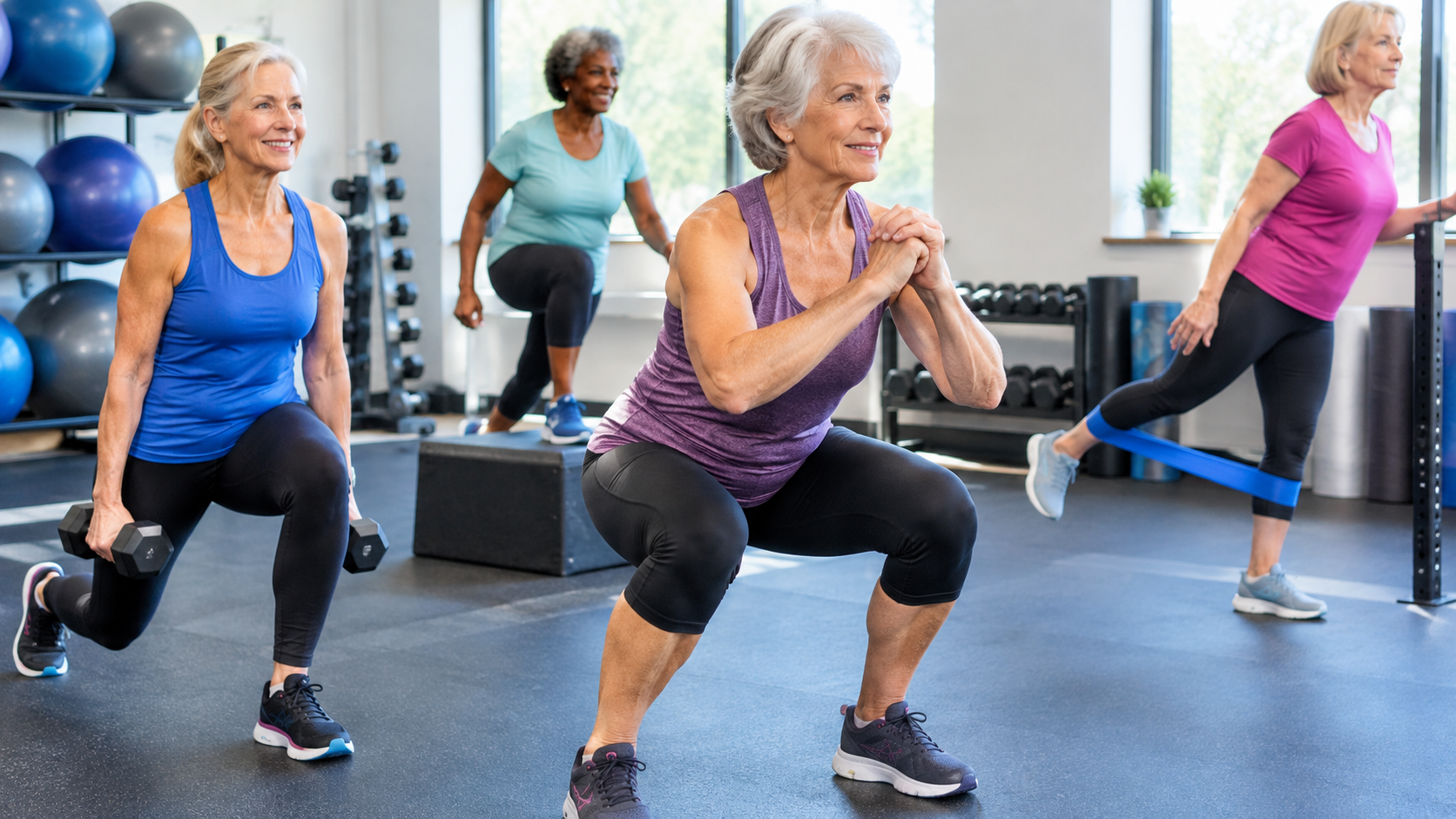
Senior fitness is often discussed as though growing older automatically means becoming weaker, slower, and less physically capable. Research provides a different perspective. A Harvard Medical School study examined whether women age 70 and older with mobility limitations could improve their physical capabilities through a specific form of resistance training. The results provide important evidence for what senior fitness can accomplish when exercise is designed around strength, power, and functional movement. The study, conducted by Bean and colleagues and published in 2004, examined a program called InVEST, or Increased Velocity Exercise Specific to Task. The researchers wanted to determine whether high-velocity, task-specific resistance training could improve leg power, balance, and mobility in community-dwelling older women. This is an important question for senior fitness because chronological age does not tell us everything about physical capability. The women in this study were already experiencing moderate-to-severe mobility limitations. They were not selected because they were exceptionally fit. Instead, the study examined whether targeted exercise could produce measurable improvements in women who already faced physical limitations.
1. Senior Fitness Can Target Power, Not Just Strength
One of the most important features of this study was its focus on power. Strength is the ability to produce force. Power involves producing force quickly. That distinction matters in senior fitness because many everyday movements require force to be generated rapidly. Standing from a chair, climbing a step, getting up from the floor, changing direction, or responding to a loss of balance can require the body to produce force within a short period of time. The InVEST program therefore used resistance exercises that included a high-velocity component. Participants performed the lifting portion of the exercises as quickly as possible while working against resistance. This approach makes the study particularly relevant to senior fitness programs that address more than simply maintaining muscle mass.
2. The Participants Were Women Age 70 and Older
The study included 21 community-dwelling women aged 70 and older who had moderate-to-severe mobility limitations. Participants were randomly assigned to either the InVEST exercise group or a control exercise group. Both groups exercised three times a week for 12 weeks. The InVEST group performed progressive resistance exercises using a weighted vest. The exercises were designed around functional tasks and incorporated rapid movement. For senior fitness, the participant characteristics are significant. The study was not examining teenagers, young adults, or highly trained athletes. It was examining women in their 70s and older who already had mobility limitations.
3. Senior Fitness Produced a 12%–36% Increase in Leg Power
The most striking result involved leg power. After 12 weeks, the InVEST participants demonstrated approximately 12% to 36% improvements in leg power, depending on the resistance level tested. At several higher resistance levels, the improvement in the InVEST group was significantly greater than the improvement in the control group. This finding is especially relevant to senior fitness because it demonstrates that older women with mobility limitations were capable of developing greater physical power through structured resistance exercise. The result does not mean that every person over 70 will experience a 36% increase. This was a small pilot study involving only 21 women. However, it provides direct evidence that substantial improvement in physical power is possible even among older adults who already have mobility limitations.
4. Chair-Rise Performance Improved by 44%
The researchers also measured how quickly participants could rise from a chair. The InVEST group improved chair-rise performance by approximately 44%. The control group improved by approximately 29%, with the improvement in the InVEST group significantly greater. This is particularly meaningful for senior fitness because getting up from a chair is a basic functional movement. An exercise program that improves the ability to rise from a chair is addressing an actual movement used in everyday life rather than simply improving performance on an isolated gym exercise. Functional movement is therefore an important component of senior fitness.
5. Senior Fitness Also Improved Walking Speed
The InVEST group improved gait speed by approximately 16%. The control group did not demonstrate a statistically significant improvement in gait speed. Walking speed is an important measure of physical function because walking is fundamental to everyday independence. Faster gait does not automatically mean better health in every circumstance, but changes in gait performance can provide useful information about functional capacity. The study therefore provides another example of senior fitness producing measurable changes in an everyday physical ability.
6. Balance Improved, With an Important Qualification
Balance was also measured. The InVEST group increased unilateral-stance time by approximately 50% from baseline. However, the improvement was not significantly greater than the improvement in the control group. That distinction is important when interpreting the study. The results show that balance performance improved within the InVEST group, but the researchers could not conclude that InVEST was superior to the control exercise program for balance. For senior fitness research, this illustrates why individual outcomes need to be examined separately rather than treating an exercise program as successful or unsuccessful based on one overall label. The strongest between-group findings in this study involved leg power and chair-rise performance.
7. Senior Fitness Can Challenge the Assumption of Inevitable Physical Decline
The broader significance of the study is straightforward. The women participating in this research were 70 or older and already had significant mobility limitations. After 12 weeks of structured exercise, they demonstrated substantial improvements in leg power and functional performance. That finding challenges the assumption that physical decline associated with aging means older adults are incapable of developing greater physical capability. Senior fitness does not mean pretending that aging does not occur. It means recognizing that aging and physical decline are not interchangeable concepts. People age. Physical capabilities can also change with age. But the study demonstrates that some aspects of physical capability remain trainable. That distinction is central to senior fitness.
What This Study Does—and Does Not—Show
The study provides evidence that high-velocity, task-specific resistance training can improve certain aspects of physical performance in women aged 70 and older with mobility limitations. It does not demonstrate that exercise stops aging. It does not demonstrate that every older adult will achieve the same results. It was a small pilot study with only 21 participants and a 12-week intervention. It also does not establish that the InVEST approach was superior to the control program for every outcome. Balance and overall physical-performance scores improved, but the between-group differences for those measures were not statistically significant. The findings are strongest for leg power and chair-rise performance. That makes the study useful for understanding what senior fitness can potentially accomplish without overstating the evidence.
The Bigger Lesson for Senior Fitness
The most useful lesson from this research is not that older adults should exercise in exactly the same way as younger people. The lesson is that exercise can be designed around the physical capabilities that matter. Senior fitness can include resistance training. It can address strength. It can address power. It can incorporate functional movements. It can measure changes in performance rather than assuming that chronological age determines the outcome. The Harvard study provides a concrete example: women age 70 and older with mobility limitations trained for 12 weeks and substantially improved leg power and chair-rise performance. That is a powerful finding for senior fitness. Rather than viewing older adults primarily through a lens of physical decline, senior fitness can examine what they are capable of developing, maintaining, and improving. The study does not erase the biological realities of aging. Instead, it demonstrates something more useful: older adults can still train, adapt, and become physically more capable. For senior fitness, that is the finding worth remembering.


 Arabic
 French
 Spanish
 Portuguese
 Deutsch
 Turkish
 Dutch
Dutch
 Italiano
 Russian
 Romaian
 Portuguese (Brazil)
 Greek
Greek