

 Course Catalog
 Laura Artman
Harmony After 50: 6 Essential Ways to Restore It
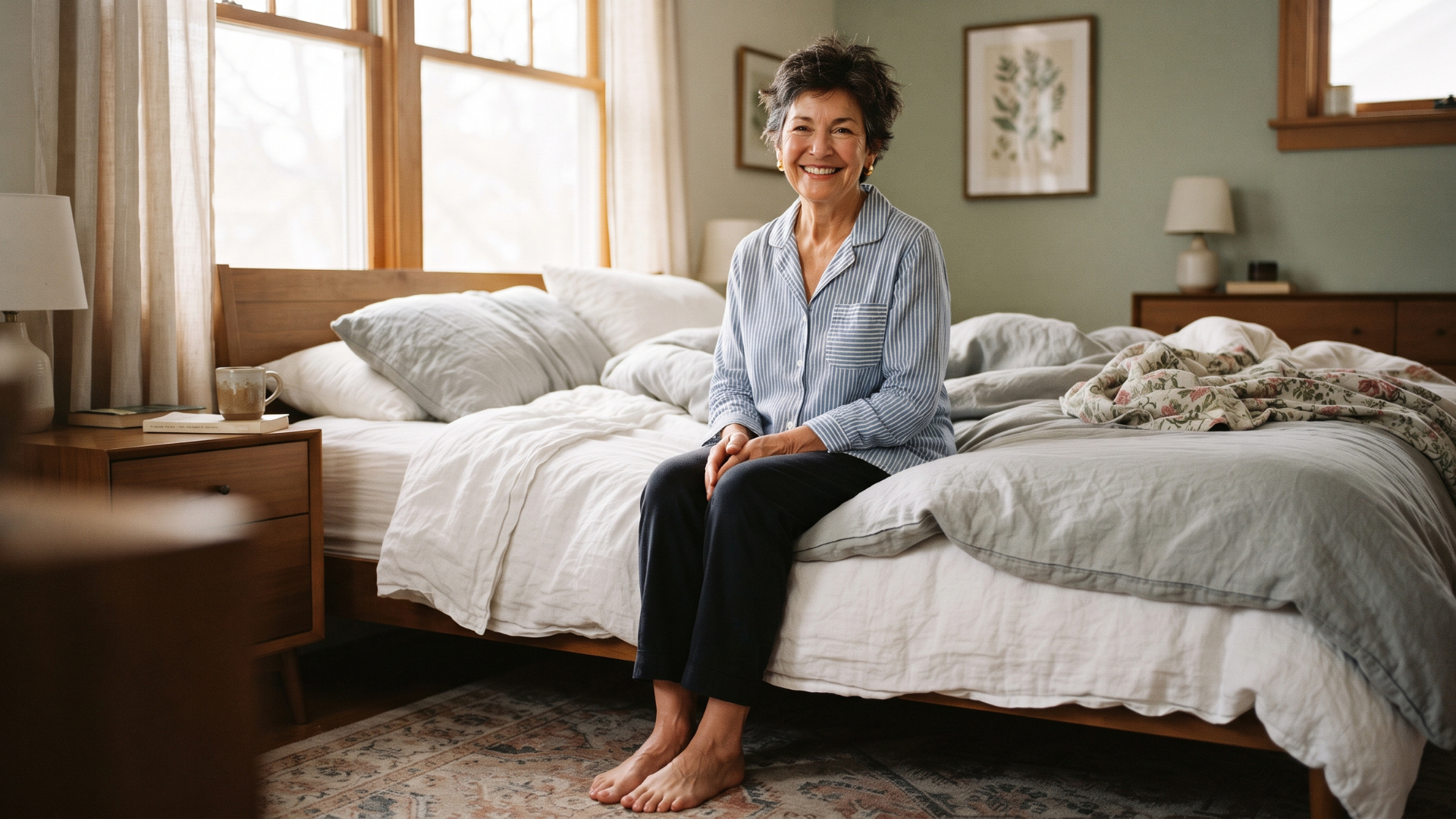
Harmony is the steady balance of mood, sleep, movement, and connection. As we age, that balance can slip, and depression can set in. Studies from Harvard, UCLA, and the University of Washington show what disrupts harmony and what helps restore it.
What Disrupts Harmony as We Age
The research points to several forces that pull harmony apart.
Biology and Personality
A UCLA review (Laird et al., 2019) found that endocrine, genetic, inflammatory, metabolic, neural, and cardiovascular processes interact to affect the risk of late-life depression. The same review reports that insecure attachment continues to raise risk in later life and that multiple personality factors increase risk.
Poor Sleep and Inflammation
Insomnia is common: 30% to 50% of older adults complain of it, according to UCLA's Dr. Michael Irwin. In a 2025 UCLA randomized trial, older adults with insomnia showed an exaggerated depressive mood and symptom response to an inflammatory challenge, compared with older adults without insomnia.
Too Little Movement
Harvard and Massachusetts General Hospital researchers (Choi et al., 2019) found that more objectively measured physical activity protects against major depression, with an odds ratio of 0.74 per standard-deviation increase in activity. Less movement means less of that protection.
Too Little Green Space
In the Harvard Nurses' Health Study (Banay et al., 2019), women living in the highest quintile of residential greenness had a 13% lower risk of depression than women in the lowest quintile.
How to Maintain and Restore Harmony
The research points to practical actions that protect mood, treat depression, or both. Here are six, starting with those backed by randomized trials.
1. Treat Insomnia to Protect Harmony
UCLA researchers led by Dr. Michael Irwin tested cognitive behavioral therapy for insomnia, known as CBT-I, in 291 adults age 60 and older who had insomnia but no depression (JAMA Psychiatry, 2022). The participants were not depressed at the start, so this shows prevention. Depression developed or returned in 12.2% of the CBT-I group, compared with 25.9% of the group that received sleep education. When insomnia stayed in remission for three years, the likelihood of developing depression fell by 83%. CBT-I teaches you to break the habits that keep you from sleeping well. Irwin concluded that targeting insomnia with cognitive behavioral therapy can prevent depression. Irwin recommends screening with the seven-item Insomnia Severity Index, a short questionnaire, and treating insomnia with CBT-I. If you sleep poorly, ask your doctor about both.
2. Join a Tai Chi Class for Mind-Body Harmony
A UCLA randomized trial led by Dr. Helen Lavretsky (American Journal of Geriatric Psychiatry, 2022) studied adults age 60 and older with major depression who were taking a standard antidepressant. Of 178 participants randomized, half took weekly one-hour Tai Chi Chih classes for 12 weeks, and half took health education classes. The primary outcome was change on the Hamilton Rating Scale for Depression, with follow-up continuing for six months. Of the 178 randomized, 125 completed the three-month assessment. Both groups improved in depression symptoms. Tai Chi Chih was superior to health education for improving general health. Tai Chi Chih is a brief, manualized version of Tai Chi, and here it was added to medication, not used in place of it.
3. Move Every Day to Keep Harmony
Harvard and Massachusetts General Hospital researchers (Choi et al., JAMA Psychiatry, 2019) used genetic data from hundreds of thousands of adults to test whether physical activity lowers depression risk. Activity measured by accelerometer was protective: each major increase cut the odds of depression by 26%. That increase equals about 15 minutes of running, or about an hour of moderate activity such as walking or gardening, in place of sitting. The researchers noted that you do not need marathons or hours of aerobics to benefit. This study included adults of all ages, not only older adults.
4. Step Outside for Natural Harmony
In the Harvard Nurses' Health Study (Banay et al., Environmental Health Perspectives, 2019), researchers followed 38,947 women, mean age 70, from 2000 to 2010. Depression was defined as a first self-report of physician-diagnosed depression or regular antidepressant use. 3,612 cases of depression occurred over 315,548 person-years. The 13% lower risk among women in the greenest surroundings did not appear to be explained by physical activity. The participants were mostly white women, and the study shows an association, not a cause. Look for parks, gardens, and tree-lined streets near where you live.
5. Build a Care Team Around You
Researchers at the University of Washington (Renn et al., Journal of the American Geriatrics Society, 2021) studied collaborative care for depression in 3,722 primary care patients at eight clinics in low-resourced rural or frontier areas of the Western United States. Clinics were followed for up to 27 months, and the main outcome was the change between each patient's first and last PHQ-9 scores. In this model, a behavioral health care manager and a psychiatric consultant support the primary care provider. Adults 65 and older improved significantly, with a PHQ-9 depression score drop 2.06 points greater than that of younger adults. This was an observational study, not a randomized trial.
6. Strengthen Resilience With Mind-Body Practices
A UCLA review (Laird et al., Translational Psychiatry, 2019) examined resilience to late-life depression. It reports that several approaches show promise for prevention and treatment: cognitive and mind-body approaches, including positive psychology, psychotherapy, heart rate variability biofeedback, and meditation; movement-based approaches, including aerobic exercise, yoga, and tai chi; and biological approaches, including medication and electroconvulsive therapy. Because this is a review, it summarizes evidence rather than testing a single program. The authors add that more research is needed to predict who responds best to each approach.
What Does Not Help: Vitamin D
Supplements are not a shortcut. In the VITAL-DEP trial (Okereke et al., Harvard/MGH, JAMA, 2020), 18,353 adults age 50 and older received vitamin D3 or placebo for a median of 5.3 years. The authors concluded that the findings do not support vitamin D3 for preventing depression.
Bring Harmony Back One Habit at a Time
Harmony does not return all at once. Start with sleep, add daily movement, try a Tai Chi class, and spend time outdoors. If depression symptoms persist, talk with your doctor about treatment.
Research References:
Factors that contribute to depression in aging
- Laird et al., UCLA (2019), Translational Psychiatry (review). Endocrine, genetic, inflammatory, metabolic, neural and cardiovascular processes interact to affect risk for late-life depression onset and course. Insecure attachment continues to increase risk in late life, and multiple personality factors increase risk.
Full text (free): https://pmc.ncbi.nlm.nih.gov/articles/PMC6375932 nihnih - Irwin et al., UCLA (2025), JAMA Psychiatry (RCT). Older adults with insomnia showed an exaggerated depressive mood and symptom response to inflammatory challenge compared with those without insomnia.
Link: https://jamanetwork.com/journals/jamapsychiatry/fullarticle/2836538 (full-text access not verified) jamanetwork - Choi et al., Harvard/MGH (2019), JAMA Psychiatry (Mendelian randomization; adults, not older-adult specific). Physical activity measured by accelerometer was protective against major depression: OR 0.74 per 1-SD increase in mean acceleration (95% CI 0.59–0.92). Lower activity corresponds to higher risk.
DOI: https://doi.org/10.1001/jamapsychiatry.2018.4175 (full-text access not verified) healio - Banay et al., Harvard (2019), Environmental Health Perspectives (Nurses’ Health Study). 38,947 women (mean age 70) were followed 2000–2010; those in the highest residential greenness quintile had a 13% lower depression risk than the lowest quintile. The association did not appear to be mediated by physical activity.
Full text (free): https://pmc.ncbi.nlm.nih.gov/articles/PMC6752939
Best things to do to counter depression
- CBT for insomnia. Irwin et al., UCLA (2022), JAMA Psychiatry (RCT, n=291, age 60+). Incident or recurrent major depression occurred in 12.2% of the CBT-I group vs 25.9% of the sleep-education group. With insomnia remission sustained for three years, there was an 83% reduction in the likelihood of developing depression.
Full text (free PDF): https://escholarship.org/content/qt3kx6w8mm/qt3kx6w8mm.pdf
Journal page: https://jamanetwork.com/journals/jamapsychiatry/fullarticle/2786738 healioCNN - Tai Chi Chih added to antidepressant treatment. Lavretsky et al., UCLA (2022), American Journal of Geriatric Psychiatry (RCT, 12 weeks, age 60+ with major depression). Both Tai Chi Chih and health education combined with a standard antidepressant improved depression symptoms. Tai Chi Chih was superior to health education in improving general health.
Full text (free): https://escholarship.org/uc/item/7bf670k1 escholarshipnih - Physical activity. Choi et al., Harvard/MGH (2019), as in Q1. About 15 minutes of vigorous activity, or about 1 hour of moderate activity such as walking or gardening, may significantly reduce risk of major depression. ideafit
- Collaborative care in primary care. Renn et al., University of Washington (2021), Journal of the American Geriatrics Society (observational, n=3,722). Older adults (65+) showed a 2.06-point greater PHQ-9 decrease than younger adults.
PubMed: https://pubmed.ncbi.nlm.nih.gov/34536286/
Journal: https://agsjournals.onlinelibrary.wiley.com/doi/epdf/10.1111/jgs.17457 (full-text access not verified) nih - No effect: vitamin D3. Okereke et al., Harvard/MGH (2020), JAMA (RCT, n=18,353, age 50+, median 5.3 years). The authors concluded the findings do not support vitamin D3 for preventing depression.
DOI: https://doi.org/10.1001/jama.2020.10224 (full-text access not verified)



 English
 Arabic
 French
 Spanish
 Portuguese
 Deutsch
 Turkish
 Dutch
Dutch
 Italiano
 Russian
 Portuguese (Brazil)
 Greek
Greek