


 My Work
 Environ
 Divorce32
During Uncertainty, a Private Social Network Outperforms a Static Website
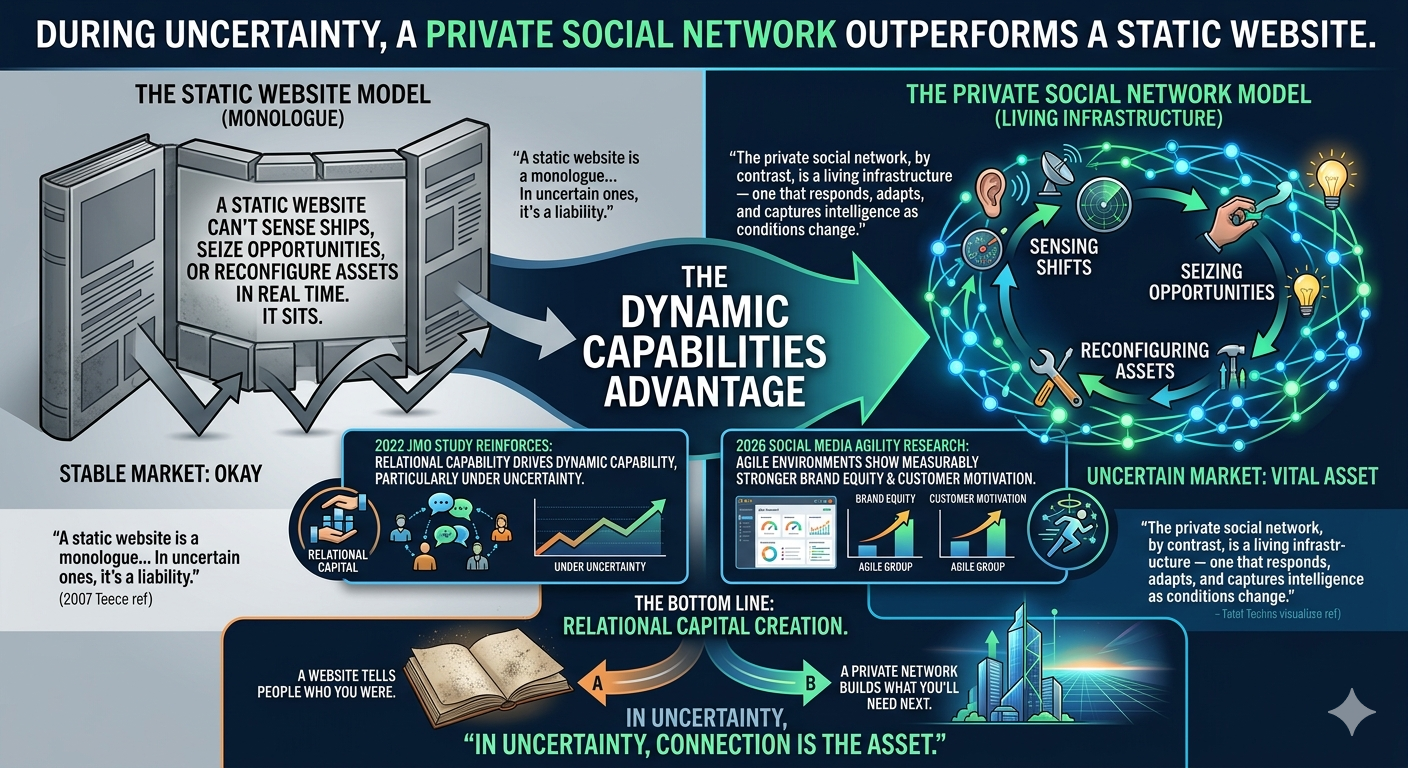
A static website is a monologue. In stable markets, that's fine.
In uncertain ones, it's a liability.
Teece's (2007) dynamic capabilities framework argues that sustainable performance depends on a firm's ability to sense shifts, seize opportunities, and reconfigure assets in real time. A static website can't do any of that. It sits. A private social network, by contrast, is a living infrastructure — one that responds, adapts, and captures intelligence as conditions change.
The 2022 Journal of Management & Organization study reinforces this directly: relational capability drives dynamic capability, particularly under environmental uncertainty. You cannot build relational capital through a brochure. You build it through interaction, dialogue, and repeated engagement — exactly what a private network enables.
The 2026 social media agility research adds another layer. Organizations that maintain agile digital engagement environments show measurably stronger brand equity and customer motivation. Agility requires a platform that moves with your audience. Static websites aren't built for that.
And when you look at emerging engagement models for 2026, the common thread is community — not content consumption, but participation.
Here's the bottom line:
When markets are unstable, your digital presence either creates relational capital or it doesn't. A website tells people who you were. A private network builds what you'll need next.
In uncertainty, connection is the asset.

 English
 Spanish
 Portuguese
 Deutsch
 Turkish
 Dutch
Dutch
 Italiano
 Russian
 Romaian
 Portuguese (Brazil)
 Greek
Greek
 Arabic